
Alaska Felony Records
Alaska felony records are held at the state level and searchable by the public online or in person. The Alaska Court System runs one unified court structure, and the CourtView portal gives anyone free access to criminal case information statewide. You can search by name or case number. For a full criminal history report, the Alaska Department of Public Safety handles those requests for a fee. This guide covers where Alaska felony records come from, how to search them, what information they include, and what state laws control public access to criminal history.
Alaska Felony Records Overview
Alaska Felony Records: What They Are
A felony in Alaska is any crime that carries a possible sentence of at least one year in a state correctional facility. Alaska law classifies felonies into four levels. Unclassified felonies cover the most serious offenses, such as murder and certain sexual assaults, and carry the stiffest penalties. Class A felonies are next. Then come class B and class C felonies. Class C felonies sit at the lower end of the scale, though they still result in a felony conviction. These levels show up on criminal records, and the classification affects sentencing under AS 12.55, which governs sentencing and probation for felony convictions statewide.
Unlike most states, Alaska does not run its court records through individual borough or county offices. The state operates a single unified court system. All felony cases go through the Alaska Court System, which covers 30 boroughs, census areas, and municipalities. The four judicial districts are the First District covering southeastern Alaska, the Second District covering northern and western Alaska, the Third District covering Anchorage and south-central Alaska, and the Fourth District covering the interior. Each district has Superior Courts that handle felony cases and District Courts that handle preliminary hearings, misdemeanors, and related matters. This structure means you search statewide, not jurisdiction by jurisdiction.
Felony court records in Alaska are public documents. Under AS 40.25.110-120, the Alaska Public Records Act, the public has a right to access government records. Criminal court records fall under this law with some exceptions. Cases involving juveniles, sealed records, and certain protective orders are restricted. Cases dismissed at the first hearing may be removed from public search portals. Under AS 22.35.030, the court may not publish a criminal case record on a public website once 60 days have passed since acquittal or dismissal of all charges.
CourtView: Free Alaska Felony Case Search
CourtView is the main tool for searching Alaska felony records online at no cost. The Alaska Court System search portal connects directly to trial court case data from every judicial district in the state. You search by party name, case number, or citation and ticket number. Results display case status, hearing dates, charges filed, party names, and docket entries going back to 1990 for most courts. Some courts have records further back if cases were reopened. The system also links to the Appellate Case Management System for Supreme Court and Court of Appeals cases.
The portal leads to CourtView Public Access, which covers both Superior Courts and District Courts statewide. Superior Courts handle felony criminal cases, civil cases over $100,000, domestic relations, probate, and appeals from District Court. District Courts handle misdemeanor criminal cases, civil matters up to $100,000, small claims up to $10,000, traffic violations, and preliminary hearings for felonies. Felony cases that start with a preliminary hearing at the District Court level move up to Superior Court for trial and sentencing. Both sets of records are visible in CourtView.
The Alaska Court System search cases page is the best starting point when looking for Alaska felony records online. It gives you links to CourtView and explains what each portal covers.
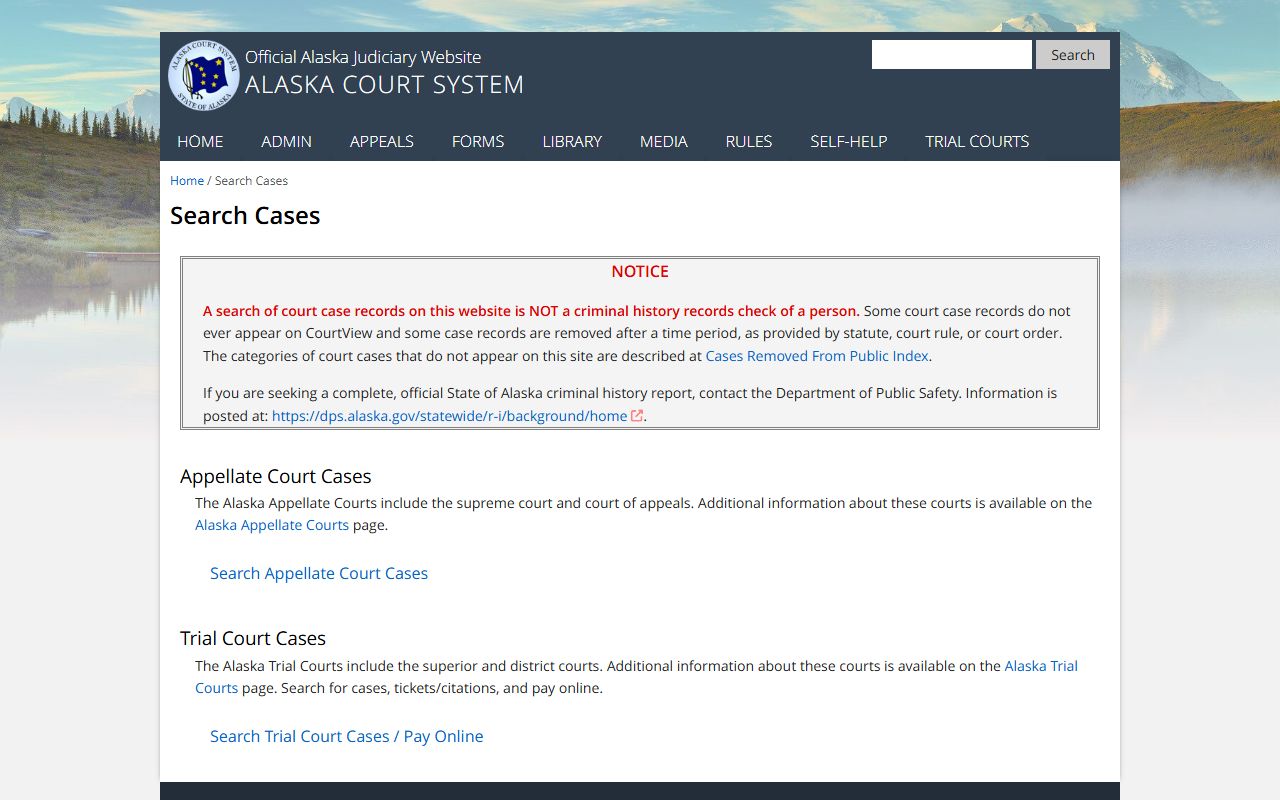
From here you can reach every trial court in Alaska and run a statewide name search across all open and closed felony cases.
CourtView has some important limits. Records of defendants who were under 21 years old at the time of the offense may be restricted. Cases where the defendant was discharged and acquitted are sometimes removed. Domestic violence protective orders and certain stalking cases may be restricted as well. For cases not showing up online, you can contact the court clerk directly or submit a formal records request using the TF-311 forms available on the Alaska Court System forms page.
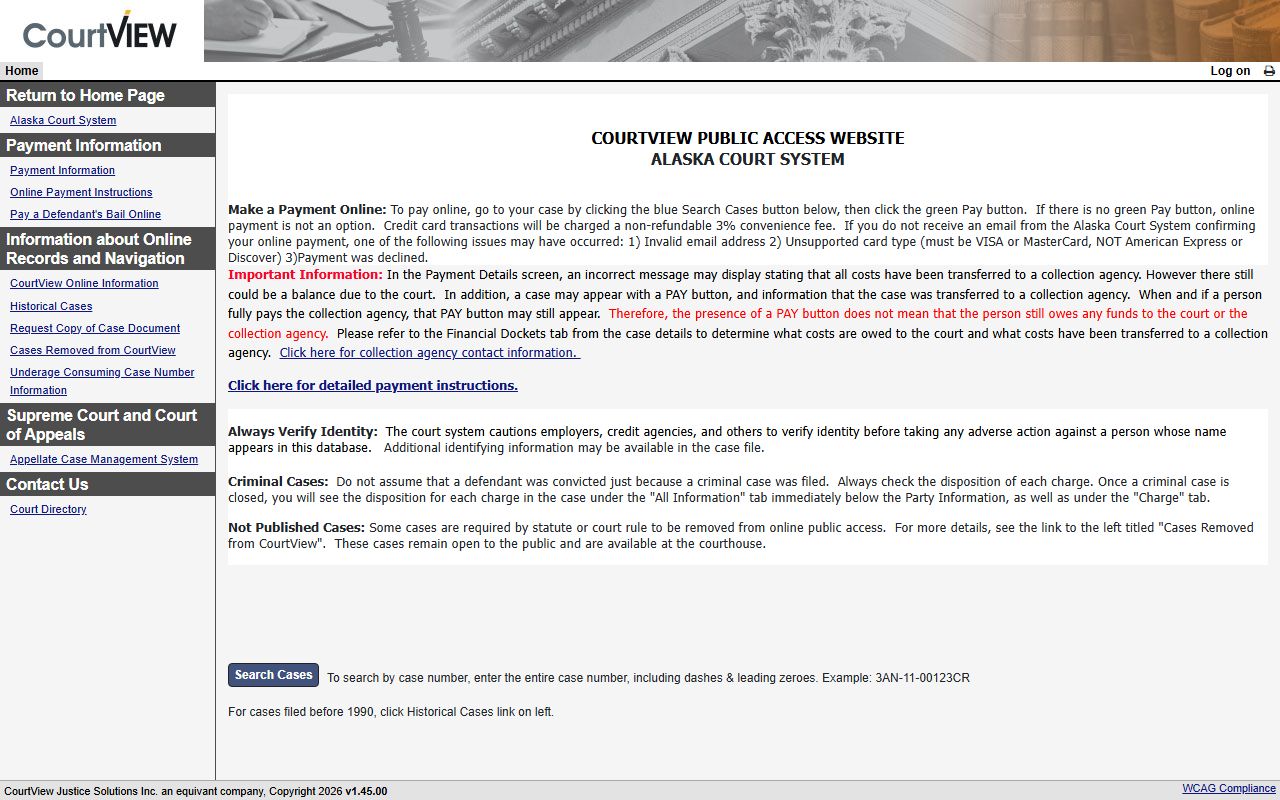
CourtView shows case summaries with file numbers, case participants, filing dates, hearing schedules, charges, and disposition details for felony cases filed across all Alaska courts.
Alaska Criminal History Background Checks
The Criminal Records and Identification Bureau of the Alaska Department of Public Safety keeps the central repository for criminal history information in Alaska. Under AS 12.62.160, any person may receive Alaska criminal justice information. This is broader access than in many states. The report covers adult arrests and convictions for misdemeanors and felonies. Infractions, violations, and most juvenile offenses are not included. The report will show convictions, dismissed cases, not-guilty findings, and past conviction information.
A name-based criminal history check costs $20. A fingerprint-based check costs $35. Each extra copy ordered with the first request costs $5. Coming back later for another copy costs $20. Submit requests online through the DPS self-service email portal, in person at 5700 East Tudor Road in Anchorage, or by mail with a completed form. Walk-in service is available Monday through Friday from 8:15 AM to 4:00 PM. You need two forms of photo ID. One must be government-issued. Third-party requests for someone else's record require the subject's signed consent and a completed Unsworn Falsification Statement. The main phone number is (907) 269-5511.
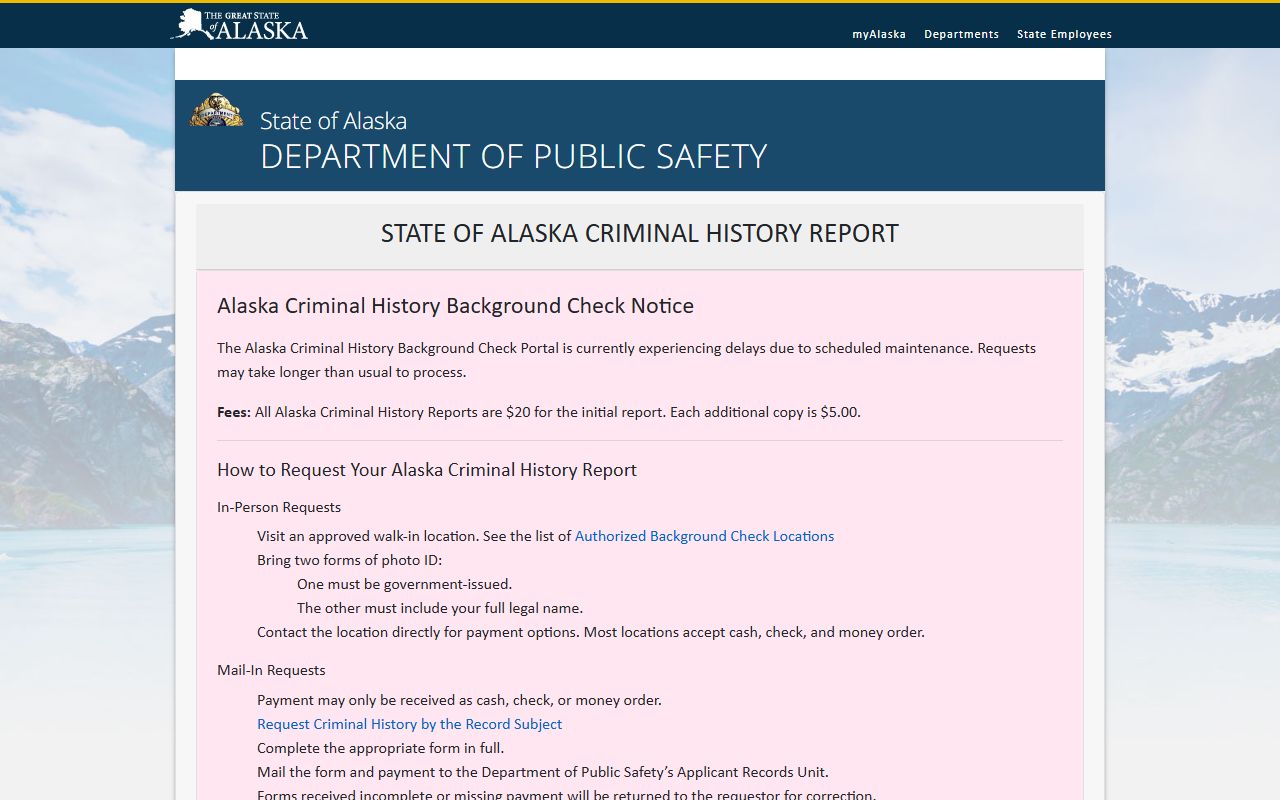
The DPS self-service portal lets you start a name-based or fingerprint-based criminal history request online and receive results by email.
VINE: Alaska Inmate Search and Notifications
VINE stands for Victim Information and Notification Everyday. The Alaska Department of Corrections operates this free service through VINELink. Anyone can use it to look up an offender's current custody status and register to get alerts when that status changes. Notifications come by phone, text, or email. The service is anonymous. The offender will not know you have registered or searched. You can call 1-800-247-9763 to use the phone-based lookup or to register for notifications. A TTY line is available at 1-866-847-1298.
Search by name or offender ID on the VINELink website. Results show the current facility, custody status, and other details on file. Register for alerts and you receive a call or message any time the offender is released, transferred, escapes, is placed on electronic monitoring, or dies in custody. Write down your four-digit PIN and keep it somewhere safe. Use a direct phone line, not one connected to a switchboard, when you register for calls.
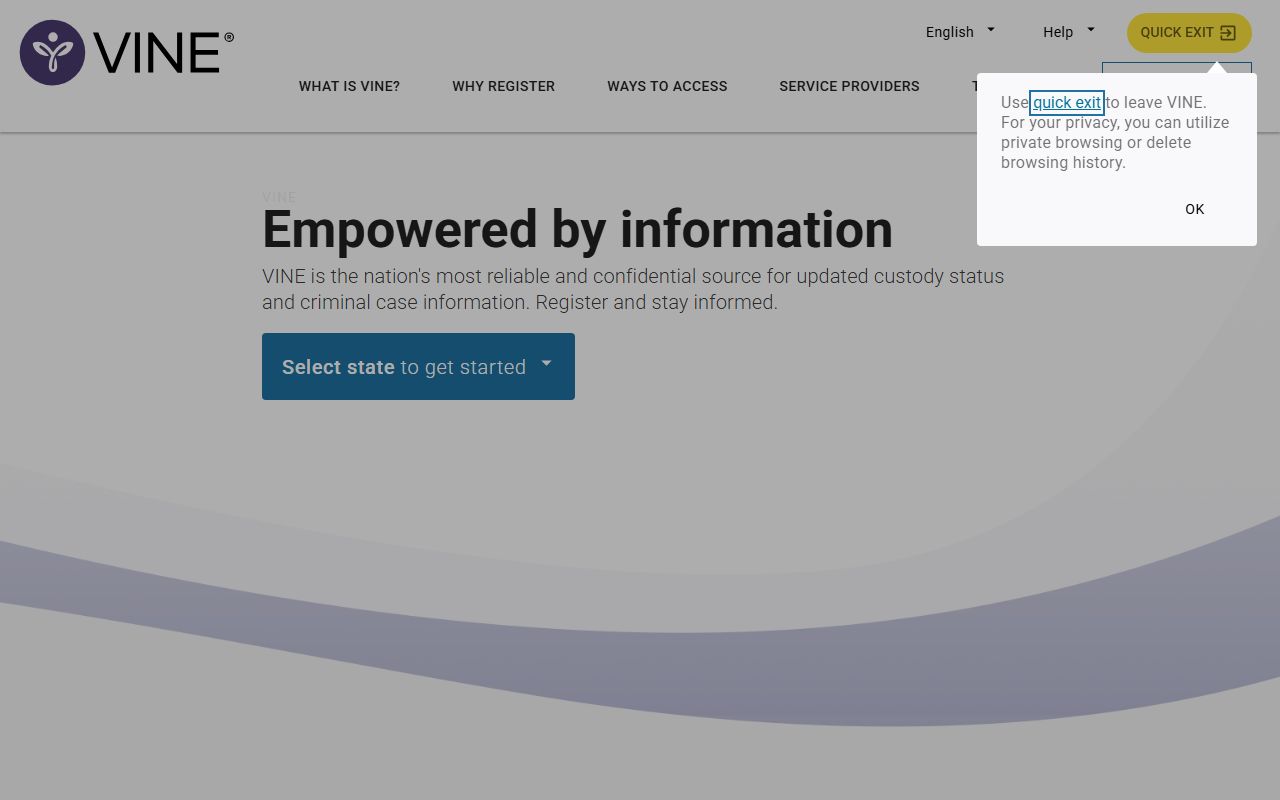
VINELink is available 24 hours a day and covers inmates held in all Alaska Department of Corrections facilities statewide.
Alaska Sex Offender Registry
The Alaska Sex Offender Registry is a public database run by the Department of Public Safety. The Alaska Sex Offender Registration Act, found at AS 12.63.010, requires people convicted of qualifying sex offenses or child kidnapping to register and re-register periodically with the Alaska Department of Corrections, Alaska State Troopers, or local police. The registry is searchable by name, ZIP code, or city. It shows each registrant's home address, work address, photo, physical description, vehicle information, date of birth, offense of conviction, date of conviction, and compliance status with registration requirements.
Registration periods vary. Some sex offenders register for 15 years. Others register for life. The level of offense, criminal history, and number of offenses and victims all play a role in determining how long someone must register. The registration period begins when the person is released from prison but does not start running until they are off probation. Sex offenders must register within 30 days of release from a correctional facility. Failure to register is a separate felony offense in Alaska.
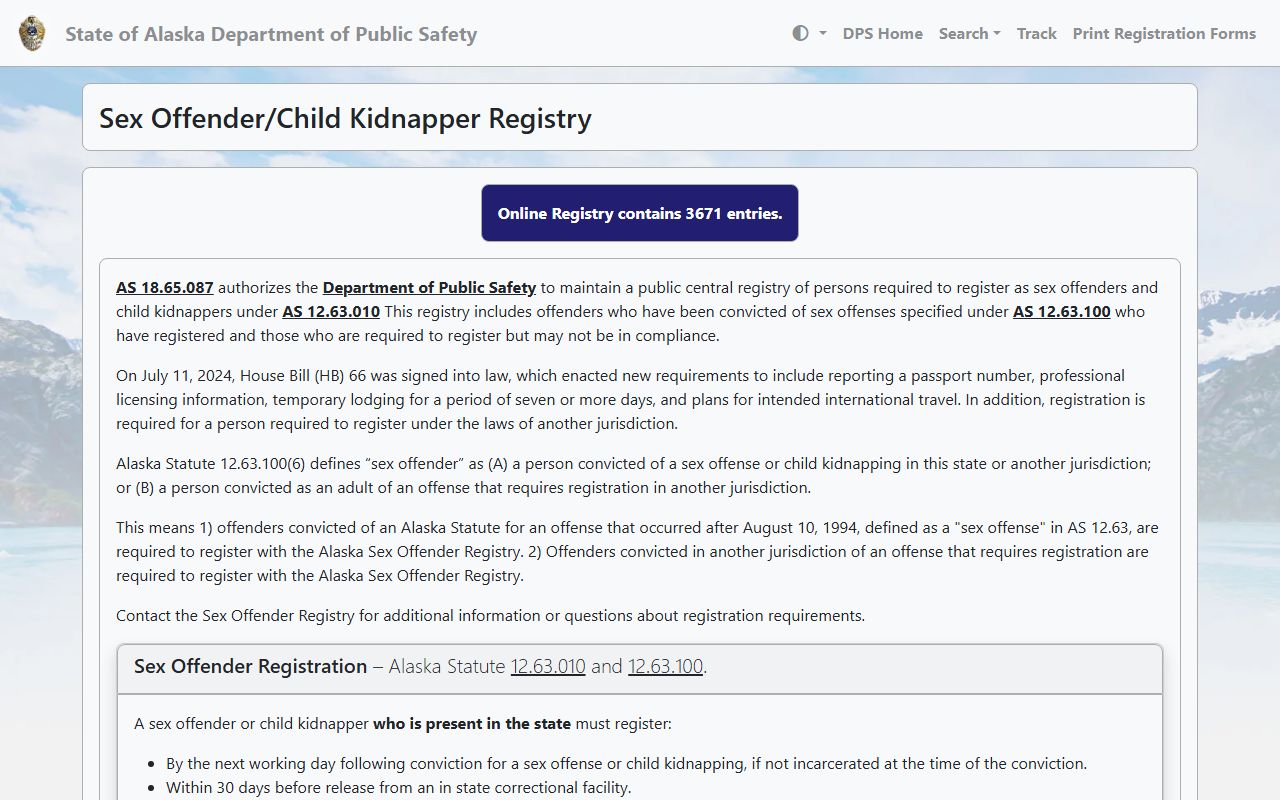
The Alaska Sex Offender Registry updates regularly and is one of several public tools for searching felony records related to sex crimes in the state.
Alaska Department of Corrections Facilities
The Alaska Department of Corrections oversees 13 state-operated correctional facilities. Major facilities include the Anchorage Correctional Complex in Anchorage, Fairbanks Correctional Center in Fairbanks, Spring Creek Correctional Center in Seward, Hiland Mountain Correctional Center in Eagle River, Goose Creek Correctional Center in Wasilla, Wildwood Correctional Complex in Kenai, Palmer Correctional Center in Palmer, Yukon-Kuskokwim Correctional Center in Bethel, Ketchikan Correctional Center in Ketchikan, and Lemon Creek Correctional Center in Juneau. The DOC also operates pretrial facilities including the Mat-Su Pretrial Facility in Palmer. Records of inmates in DOC custody are searchable through the VINE system or by contacting the facility directly. The Juneau office is at P.O. Box 112000, Juneau, AK 99811-2000, and can be reached at (907) 465-4652. The Anchorage office is at 550 West 7th Avenue, Suite 1800, Anchorage, AK 99501, phone (907) 334-2381.
Alaska State Troopers, under the AST division of the Department of Public Safety, provide law enforcement coverage throughout the state. They are divided into four detachments. A Detachment covers Anchorage, the Kenai Peninsula, and the Mat-Su Valley. B Detachment covers Southeast Alaska including Juneau, Ketchikan, and Sitka. C Detachment covers Western Alaska including Nome, Kotzebue, and Bethel. D Detachment covers Interior Alaska including Fairbanks, Delta Junction, and Tok.
How to Request Alaska Felony Court Records
The Alaska Court System uses standardized forms for records requests. The TF-311 series forms are the right tool for most requests. TF-311 covers all court locations except Anchorage, Palmer, and Fairbanks, which each have their own versions: TF-311 ANCH, TF-311 PA, and TF-311 FBKS. You can submit a request by mail, email, fax, or in person during business hours. If you provide a case number, there is no research fee. Without a case number, the court charges $30 per hour to locate records.
Copy fees are set statewide. Plain copies cost $5 for the first document and $3 for each additional document. Certified copies are $10 for the first copy and $3 for each additional certified copy. Exemplified or authenticated copies cost $15 each. Audio recordings of proceedings cost $20 per CD. More information on how to request records from any trial court is at the Alaska Court System's court records page.
You can view case files in person at any courthouse during business hours. Staff can help locate records but cannot give legal advice.
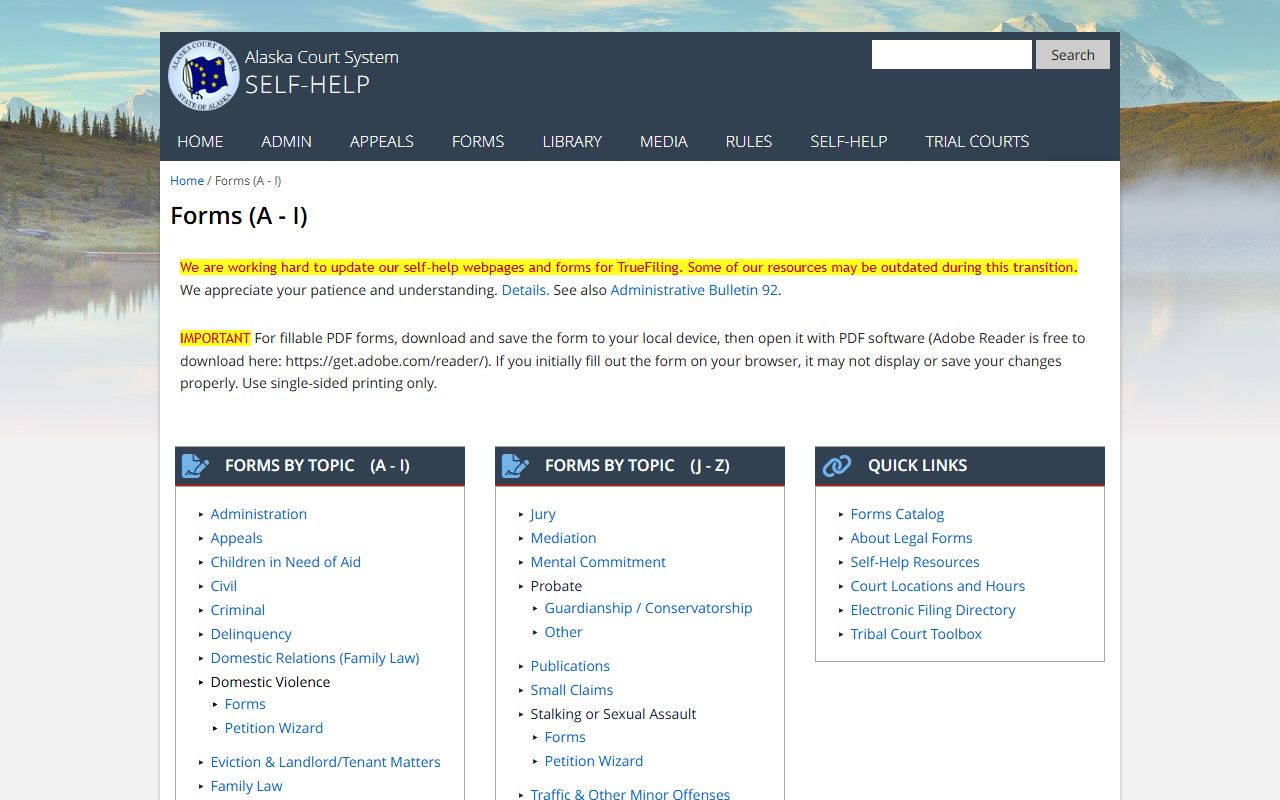
The TF-311 forms on the Alaska Court System website cover requests for copies of criminal case documents from trial courts across the state.
The Self Help Center on the Alaska Court System website provides guides and information for people who want to understand court records, navigate the records request process, or find out whether certain records may be sealed under Alaska law. It covers topics such as criminal records, how to read a docket, and how to request certified copies.
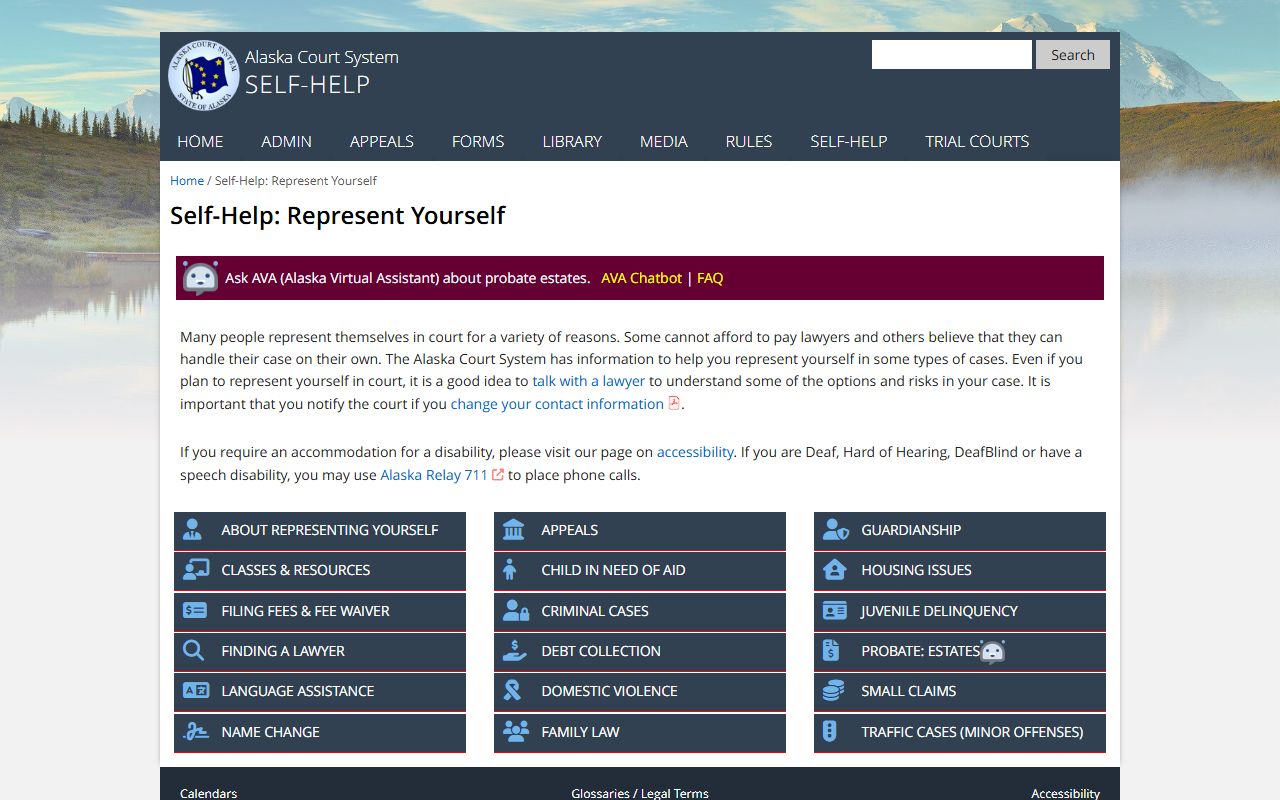
The Self Help Center gives step-by-step guidance on many court processes, including how to find and request criminal case records across the state's court system.
Historical Alaska Criminal Records
The Alaska State Archives maintains historical court records including felony records from earlier periods. The Archives are at 395 Whittier Street, Juneau, AK 99801. Call (907) 465-2270 for information. For old inmate records, territorial-period criminal cases, or historical court proceedings from before 1990, this is the right place to contact. Some records go back to the territorial period before Alaska became a state in 1959. Court proceedings from early statehood and historical corrections records may be accessible through the Archives when they are not available through CourtView. The Alaska State Archives is part of the state government and maintains a searchable finding aid on their website.
The Alaska State Archives in Juneau holds historical felony records, old inmate files, and court proceedings from Alaska's territorial period and early statehood that are not available in the online CourtView system.
Alaska Office of Victims' Rights
The Alaska Office of Victims' Rights provides assistance to crime victims navigating the court system and accessing records. Under AS 12.72, crime victims have specific rights regarding notification of hearings, release of defendants, and access to case information. The Office can help you understand those rights, register for VINE notifications, and access victim compensation programs. The office is at 1007 West 3rd Avenue, Suite 205, Anchorage, AK 99501. Phone is (907) 754-3460. A toll-free number is available at 1-844-754-3460.
Victims in felony cases have a right to be notified of hearings, parole proceedings, and releases. The Office can assist when those notifications are not happening as required by law.
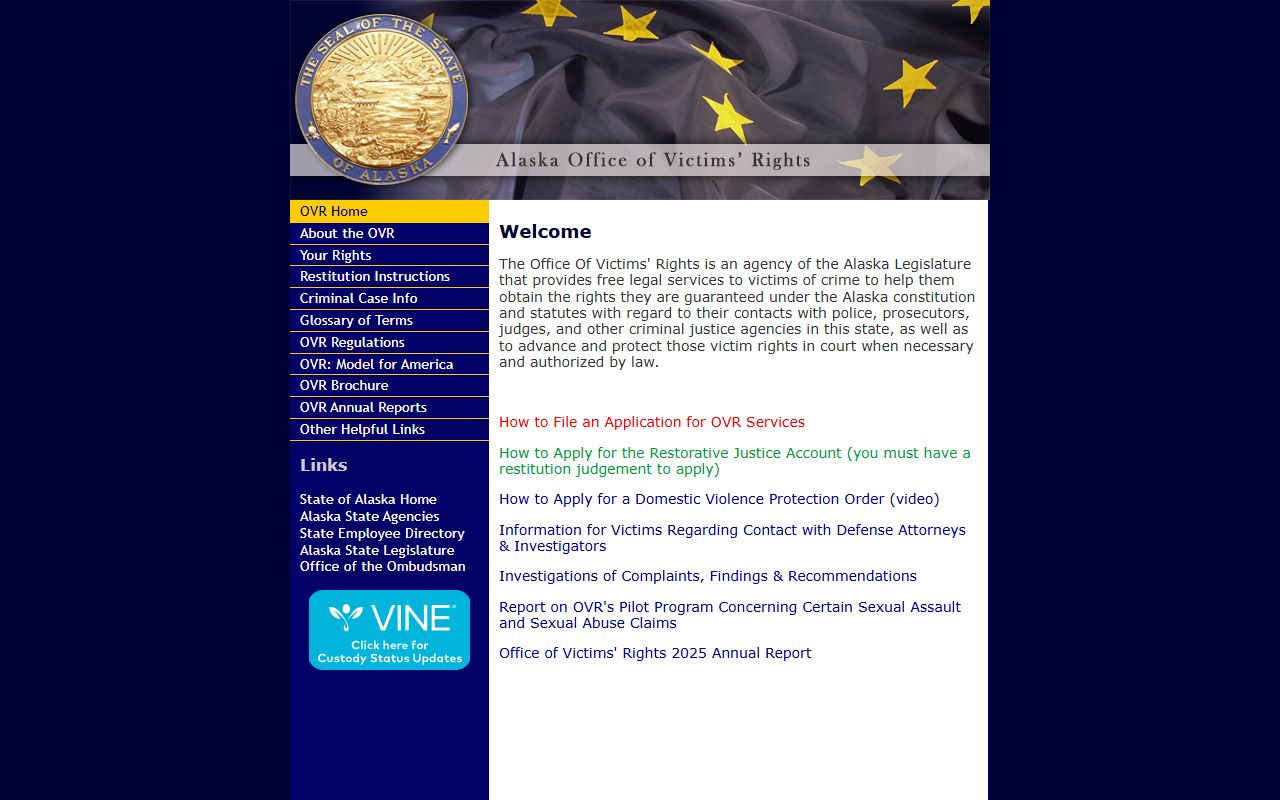
The Alaska Office of Victims' Rights is a legislative agency that operates independently of the courts and the executive branch, giving it the ability to advocate for victims across all parts of the justice system.
Alaska Laws on Felony Records Access
The main statute governing criminal records in Alaska is AS 12.62. This chapter sets out how criminal history records are maintained, who can access them, what fees apply, and how errors can be corrected. Under AS 12.62.110-120, the state maintains a central repository of criminal history information. Under AS 12.62.160, any person can request a criminal history report, which makes Alaska more open than many other states on this point. Criminal justice agencies must maintain records of all information releases for at least three years. Background check requests by third parties require the written consent of the subject, per AS 12.62.160. Fingerprint-based checks require an FBI Form FD-258 in addition to the standard request form.
Sealing records is addressed in AS 12.62.190. Records may be sealed under specific circumstances, such as mistaken identity. Sealed records are not deleted. They are kept but access is limited. Alaska has narrow expungement law. Eligibility is limited to arrests that did not lead to charges, dismissed cases, acquittals, set-aside convictions, pardons, and mistaken identity situations. To pursue expungement, you file a petition with the Alaska Court System. If the court grants it, the record is sealed from public view but remains accessible to law enforcement agencies. For correction of a criminal history record with errors, you can submit a written request under AS 12.62.180 to the agency holding the record. If you disagree with their decision, it may be appealed to court.
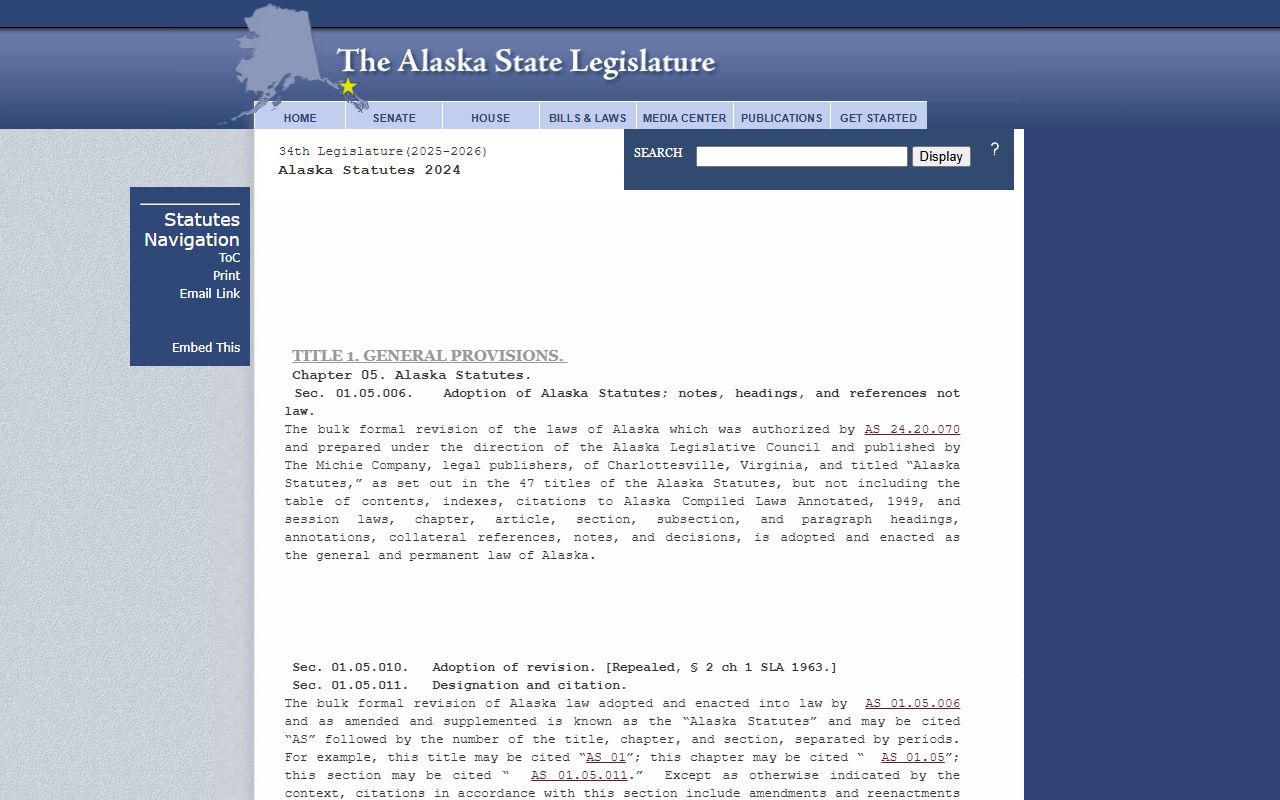
The Alaska Statutes are published online at the Alaska Legislature website and include the full text of AS 12.62 and related code sections governing criminal records, background checks, and public access to felony case information.
Browse Alaska Felony Records by Location
Alaska felony records are filed through the state court system, but each borough and census area has its own courthouse, law enforcement agencies, and local procedures. Browse by location below to find court contact details, local police and trooper information, and resources specific to where a case was filed.
Browse by Borough
Alaska has 30 boroughs, census areas, and municipalities. Click a location below to find court information, law enforcement contacts, correctional facilities, and local records access details.
View All 30 Alaska Boroughs and Census Areas →
Browse by City
Major Alaska cities are served by state courts in their region. Use these links to find city-specific court locations, local police departments, and how to search for felony records tied to a specific city.