
Eagle River Felony Records
Eagle River felony records are public documents held by the Alaska Court System and the Anchorage Police Department. Eagle River is a community inside the Municipality of Anchorage, so its criminal cases run through Anchorage courts and APD. You can search Eagle River felony records for free using the CourtView public access system, or you can request case files and police reports in person or by mail. Both sources are open under Alaska law. This guide covers the main offices, how to access records, and what to expect when you search.
Eagle River Felony Records Overview
Eagle River Criminal Records Online
The quickest way to look up Eagle River felony records is through CourtView Public Access. This free tool is run by the Alaska Court System and is open to the public around the clock. You can search by name, case number, or type of charge. Results pull from the Third Judicial District, which covers Eagle River as part of the Municipality of Anchorage. You don't need to sign in or pay anything to run a basic name search.
CourtView lists filed felony cases, dates of hearings, case status, and the judge assigned. It also shows whether a case is open or closed. Sealed records appear in the system but their details are blocked. Cases involving juveniles or protected victims are the most common reason for sealing. If you see a sealed case and need the contents, you would have to file a court motion to request access.
Older closed cases go back years in the CourtView database. If you're doing a thorough search, it helps to try different name spellings. Some records were entered with errors that can affect search results.
Nesbett Courthouse and Third District Court
Eagle River felony cases are handled by Anchorage courts at the Nesbett Courthouse, located at 825 West 4th Avenue, Anchorage, AK 99501. The phone number is (907) 264-0514. The Superior Court at this address handles all felony charges for the Third Judicial District, including cases that arise in Eagle River. The District Court at the same location covers misdemeanors and lower civil claims.
You can reach the court by phone or send a written records request by mail. The Anchorage Trial Courts directory lists all departments, contact emails, and addresses for specific case types. If you have a case number, bring it when you go in person. Without one, clerks may charge a research fee to find your records. That fee is $30 per hour for staff time spent locating files.
Copy fees apply to all court records. Plain copies cost $5 for the first page and $3 for each page after that. Certified copies cost $10 for the first page and $3 for each additional. You can pay by check made out to the Alaska Court System. Mail requests are accepted and most turnaround within a week or two depending on staff workload.
Note: If you need a certified copy for a legal filing or immigration matter, request it specifically when you submit your records request.
Anchorage Trial Courts Directory
The Anchorage Trial Courts directory is the official listing for all courts serving the Third Judicial District. Because Eagle River falls inside the Anchorage municipality, this directory applies directly. It shows each court's address, phone, fax, and which records clerk handles which case types.
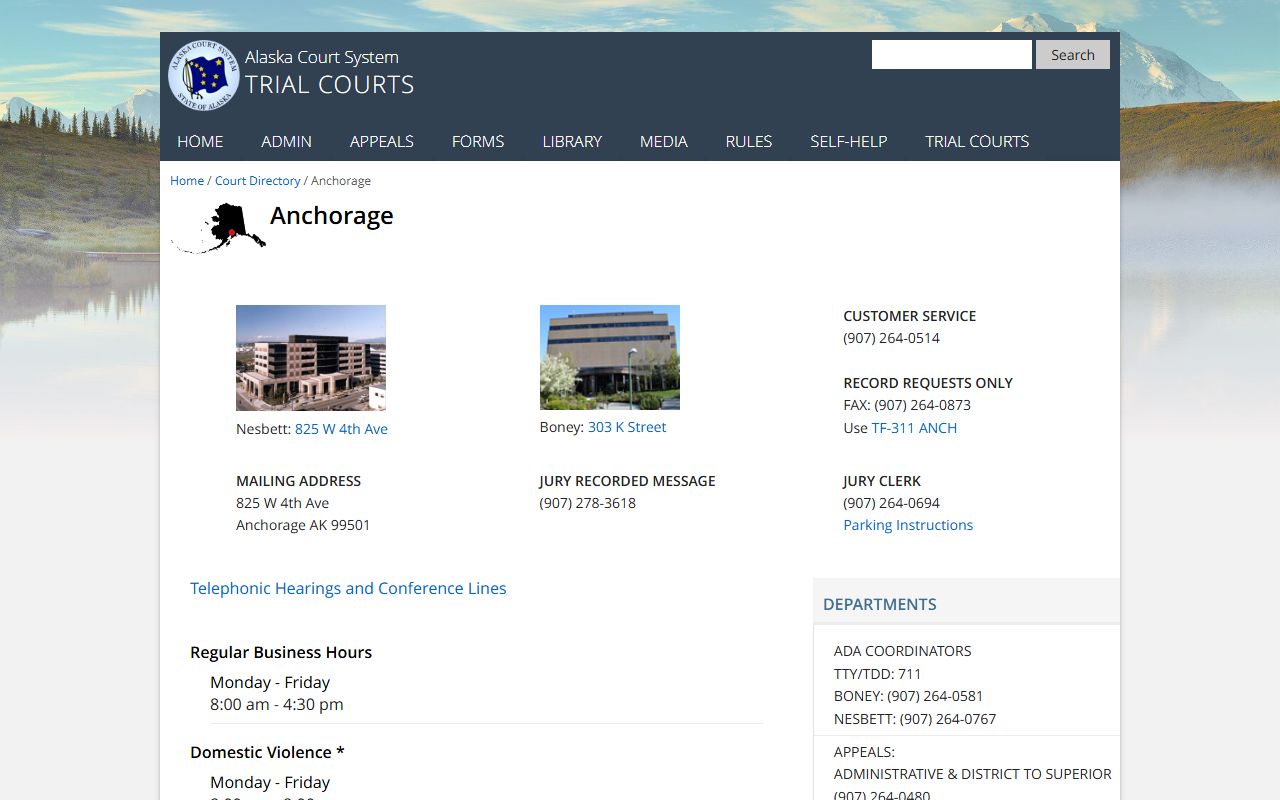
This directory is useful when you need to know whether to contact the Superior Court or the District Court for a specific case. Felony cases go to Superior Court. If you're unsure which court holds your records, calling the main courthouse line first saves time.
Anchorage Police Department Records
The Anchorage Police Department handles all law enforcement for Eagle River. APD is the agency that creates arrest records, incident reports, and other police documents for this area. Its main office is at 716 West 4th Avenue, Anchorage, AK 99501, and the main line is (907) 786-8500. Records requests go through the APD Public Records Center.
APD records are kept separate from court records. A police report might exist even if no charges were filed or if a case was dismissed. That means you may find APD records related to a person that don't show up in CourtView. The reverse is also true. Court records can exist for cases where the original police report was handled by another agency, like the Alaska State Troopers.
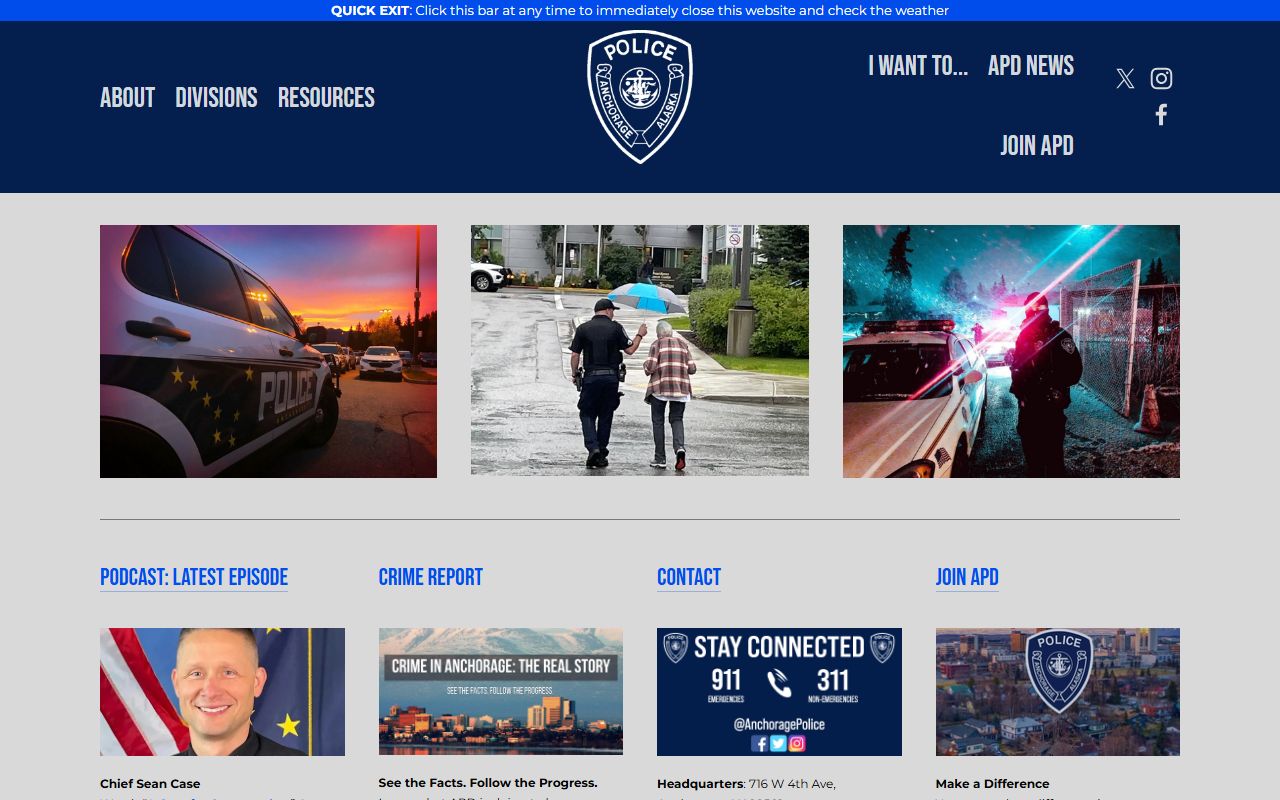
When you submit an APD records request, submit only one case or incident number per request. Police reports and media files like body camera footage are separate request types. Personal records requests require a signed consent form. APD can be reached online through its website at anchoragepolice.com.
Alaska Background Check Program
The Alaska Department of Public Safety handles the state's official criminal background check service. For Eagle River residents and those searching records in this area, the Anchorage DPS office is at 5700 East Tudor Road, Anchorage, AK 99507, phone (907) 269-5767. Office hours run Monday through Friday, 8:15 AM to 4:00 PM.
The Alaska DPS background check program offers name-based checks for $20 and fingerprint-based checks for $35. Fingerprint checks are more complete because they search both Alaska and federal criminal databases. Name-based checks are faster but can miss records if a name or date of birth was entered differently in a source system.
Two forms of photo ID are needed for in-person requests at the DPS office. At least one must be a government-issued document. Walk-in service and fingerprinting are both available on-site. Criminal records in Alaska are governed by AS 12.62, which sets the rules on who can access what. Felony records are generally public, and most stay accessible permanently.
Inmate Lookup and VINE
To find out if someone is currently in custody, use the VINE system. VINE stands for Victim Information and Notification Everyday and is available at VINELink or by calling 1-800-247-9763. The service runs 24 hours a day and covers all Alaska detention facilities.
For Eagle River, pretrial felony defendants are typically held at the Anchorage Correctional Complex. VINE tracks custody status and sends alerts when an inmate is released, transferred, or has a change in status. It's free to use and no account is required for basic lookups.
Sex Offender Registry for Eagle River
The Alaska Sex Offender Registry is a free public tool that lists people convicted of qualifying sex offenses in Alaska, including those who live or work in Eagle River. You can search by name or by geographic area. The registry shows current addresses, offense details, and registration status. It is maintained under AS 12.63.010.
The registry only covers sex offense convictions. Other felony types, like drug crimes or assault, don't appear here. For those, CourtView and APD records are the right tools.
Alaska Felony Classes
Alaska divides felonies into three classes under AS 11.81. Knowing the class tells you the range of possible penalties for what was charged. Class A felonies carry the longest sentences at up to 20 years. Class B tops out at 10 years. Class C maxes at 5 years. Unclassified felonies like murder have their own rules set by a separate statute.
When you view Eagle River felony records in CourtView, the charge listing usually includes the class. Keep in mind that charges can change. Plea agreements often reduce the original felony to a lower class or to a misdemeanor. The CourtView record reflects the final outcome, not just what was charged at arrest.
- Class A Felony: up to 20 years, up to $500,000 fine
- Class B Felony: up to 10 years, up to $250,000 fine
- Class C Felony: up to 5 years, up to $125,000 fine
- Unclassified Felony: sentence set by individual statute
Alaska Public Records Law
Alaska's public records act is found at AS 40.25.110-120. This law gives the public the right to access most government documents, including court filings and police reports. Government agencies must respond to records requests in a reasonable time. They can withhold records that are sealed, part of an active investigation, or listed as exempt by statute. But the default under Alaska law is that records are open, not closed.
If you are denied a records request and believe the denial was wrong, you can appeal through the court system or contact the Alaska Attorney General's office. Court forms for records access disputes are available at courts.alaska.gov/forms. The Alaska Self Help Center also provides free guidance on how the process works.
Nearby Cities
Borough Records
Eagle River is part of the Municipality of Anchorage. All felony cases from Eagle River run through the Anchorage court system and the Third Judicial District. The borough page lists additional court contacts and resources for the wider Anchorage area.